Best Microphones for Streaming (2026): Top USB & XLR Picks
Choosing the right microphone can significantly improve the clarity and professionalism of your stream's audio. This guide features the best microphones for streaming in 2026, including both plug-and-play USB models and hybrid USB/XLR models for growing systems. Recommendations are based on consensus specifications, professional ratings, and long-term user reviews from multiple independent sources. Each option balances sound quality, noise suppression, ease of use, and value for money for streamers of varying skill levels. Whether you need a simple desktop microphone or a broadcast-grade dynamic microphone with advanced DSP, this list offers reliable options widely available online. All options prioritize the features most essential for live streaming: clear voice capture, background noise processing, and intuitive controls.
Some links on this page are affiliate links. If you buy through them, we may earn a commission at no extra cost to you.
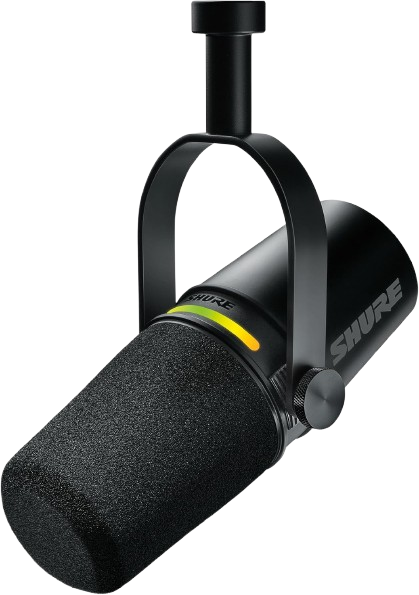
The Shure MV7+ is a hybrid USB-C and XLR dynamic microphone with advanced DSP features, including Auto Level Mode and Voice Isolation Technology. It is OBS Certified and designed for podcasters and streamers who need broadcast-quality audio in untreated rooms.
Why we love it
Dynamic capsule with tight cardioid pattern excels at rejecting background noise in untreated rooms.
Dual USB-C and XLR outputs allow seamless transition from plug-and-play to professional audio interfaces.
Auto Level Mode and digital pop filter deliver consistent, finished-sounding audio without manual gain riding.
Full-color LED touch panel provides intuitive control over mute, gain, and monitoring with visual feedback.
OBS Certified with ShurePlus MOTIV software for advanced DSP tuning and real-time denoising.
Watch out for
Higher price point reflects professional-grade features, which may be overkill for casual streamers.
USB mode limits sample rate to 48 kHz/24-bit, though sufficient for most streaming applications.
Heavier and bulkier than typical USB mics, requiring a sturdy boom arm or stand.
Best for: Streamers and podcasters who prioritize noise rejection and want a future-proof hybrid microphone with professional DSP features.
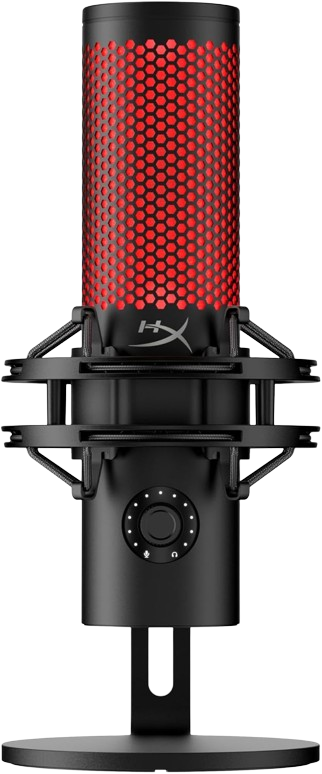
The HyperX QuadCast 2 is a versatile USB condenser microphone designed for streamers who want plug-and-play convenience with professional features. It offers 24-bit/96 kHz audio, four polar patterns, and intuitive onboard controls including a tap-to-mute sensor and multifunction knob.
Why we love it
Delivers clean 24-bit/96 kHz audio with four selectable polar patterns for flexible recording scenarios.
Tap-to-mute capacitive touch sensor with LED status indicator prevents hot-mic moments during streams.
Full-aluminum build with removable shock mount reduces desk vibrations and handling noise.
Multifunction knob allows quick adjustment of gain, monitoring volume, and polar patterns without leaving the game.
Broad compatibility with PC, Mac, PS5, PS4, Nintendo Switch, and Steam Deck for console and PC streamers.
Watch out for
Software customization (NGENUITY) is only available on Windows, limiting RGB and EQ tuning on other platforms.
Condenser capsule is more sensitive to room noise than dynamic microphones, requiring a quieter environment.
Slightly higher price point compared to entry-level USB mics, though justified by feature set.
Best for: Streamers who want a premium plug-and-play USB microphone with flexible polar patterns and intuitive controls.
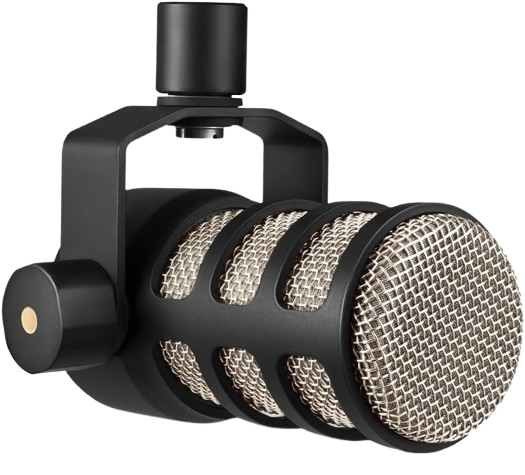
The Rode PodMic USB is a broadcast-quality dynamic microphone with built-in USB-C interface and onboard DSP. It offers dual USB and XLR connectivity for streamers who want professional sound with plug-and-play simplicity.
Why we love it
Broadcast-grade dynamic capsule delivers rich, warm voice tone with excellent background noise rejection.
Onboard DSP includes EQ, compressor, noise gate, and high-pass filter for polished audio without external processing.
Dual USB-C and XLR outputs provide flexibility for current and future audio setups.
Rode Connect software enables detailed tuning of DSP parameters and monitoring controls.
Rugged all-metal construction ensures long-term durability for daily streaming use.
Watch out for
Heavier than typical USB mics at 937g, requiring a sturdy boom arm or stand.
USB mode limited to 48 kHz/24-bit, though adequate for streaming and podcasting.
Higher price than entry-level USB mics, but justified by broadcast-quality sound and hybrid connectivity.
Best for: Streamers and podcasters who want broadcast-quality dynamic sound with USB convenience and XLR upgrade path.
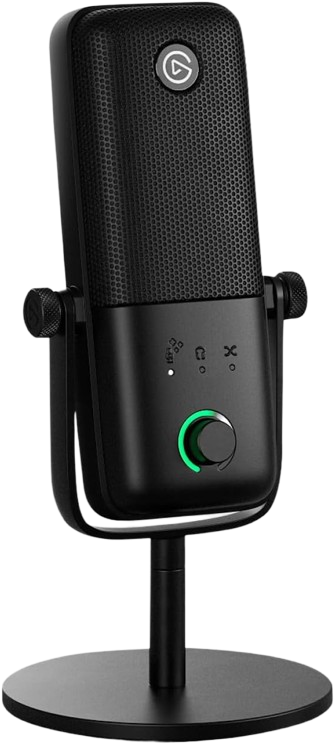
The Elgato Wave:3 MK.2 is a supercardioid condenser USB microphone with Clipguard technology and deep software integration for streamers. It offers 24-bit/48 kHz audio and seamless compatibility with Elgato's streaming ecosystem.
Why we love it
Clipguard 2.0 prevents distortion from sudden volume spikes, ideal for energetic gaming commentary.
Supercardioid pattern provides tighter off-axis rejection than standard cardioid mics for cleaner voice capture.
Wave Link software enables advanced routing, mixing, and VST plugin support for custom audio chains.
Sleek design with physical mute button and LED status indicator integrates well with Stream Deck setups.
Zero-latency 3.5mm monitoring allows real-time audio feedback without distracting delay.
Watch out for
Supercardioid pattern requires precise mic positioning to avoid off-axis tone loss.
Software features are most powerful within the Elgato ecosystem, which may limit appeal for non-Elgato users.
Condenser capsule picks up more room noise than dynamic alternatives, best suited for treated spaces.
Best for: Gamers and streamers already using Elgato hardware who want deep software integration and distortion-free audio.
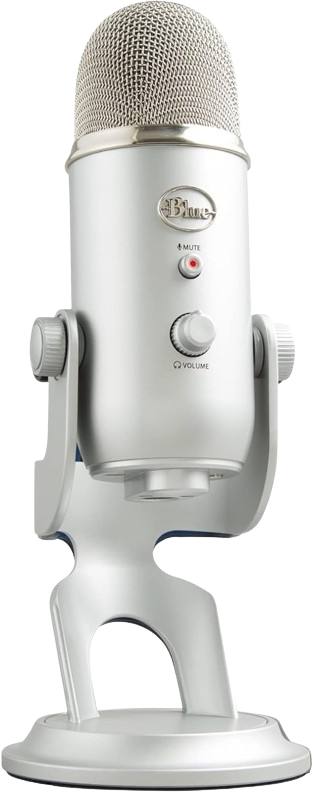
The Logitech Blue Yeti is a classic USB condenser microphone with four polar patterns and Blue VO!CE software effects. It remains a reliable workhorse for streamers who want versatile recording modes at a reasonable price.
Why we love it
Four polar patterns (cardioid, bidirectional, omnidirectional, stereo) support diverse recording scenarios.
Three-capsule condenser array delivers clear, detailed audio for voice and light music applications.
Blue VO!CE software provides real-time voice effects, noise reduction, and compression for polished streams.
Plug-and-play USB connectivity with zero-latency 3.5mm monitoring for immediate audio feedback.
Widely available and supported across Windows, macOS, and major streaming platforms.
Watch out for
16-bit/48 kHz audio resolution is lower than newer competitors offering 24-bit/96 kHz.
Condenser capsule is sensitive to room noise and requires a relatively quiet environment.
Larger footprint and weight may require additional desk space or a dedicated boom arm.
Best for: Streamers on a budget who want versatile polar patterns and proven reliability from a widely adopted USB microphone.
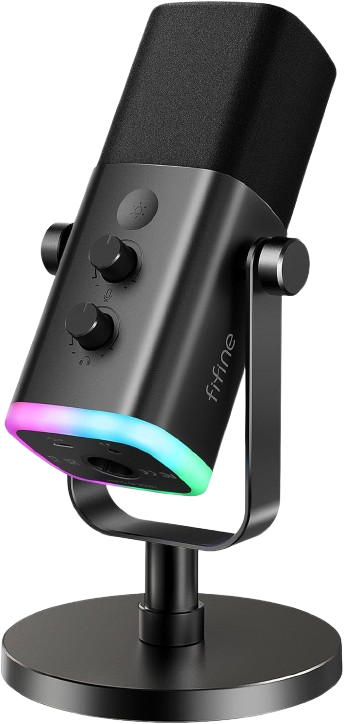
The FIFINE AM8 is a budget-friendly dynamic microphone with dual USB and XLR connectivity, RGB lighting, and touch-mute functionality. It offers surprising audio quality and features for its low price point.
Why we love it
Dynamic capsule provides good background noise rejection at a fraction of the cost of premium mics.
Dual USB and XLR outputs allow immediate plug-and-play use with future upgrade potential.
Tap-to-mute with LED indicator and RGB lighting add streamer-friendly features rarely found at this price.
Includes windscreen, desktop stand, and USB-C cable for a complete out-of-box streaming solution.
24-bit/48 kHz audio resolution delivers clear voice capture suitable for most streaming applications.
Watch out for
Build quality and materials are less robust than higher-priced microphones, though adequate for the price.
RGB lighting and software customization are basic compared to premium streaming microphones.
Frequency response is narrower (50 Hz–16 kHz) than broadcast-grade dynamic mics, limiting tonal richness.
Best for: Beginner streamers on a tight budget who want a dynamic microphone with dual connectivity and streamer-friendly features.
The HyperX QuadCast 2 microphone earns a "Best Overall" award for its exceptional balance of audio quality, feature set, and ease of use, specifically designed for streamers. 24-bit/96 kHz resolution delivers noticeably cleaner and more detailed voice capture than many competitors, while four polar patterns offer flexibility for solo streams, interviews, or ambient sound recording. A touch-mute sensor with LED status indicator is an essential feature for streamers, preventing accidental unmuting of the microphone, which could disrupt your broadcast. Onboard controls with a multi-function knob allow you to quickly adjust gain, monitoring, and polar patterns without leaving your game or streaming software. The all-aluminum housing and included shock mount ensure durability and reduce table vibration, while broad compatibility with PC, Mac, and consoles makes it a versatile choice for streamers across multiple platforms. For those looking for a high-quality, plug-and-play USB microphone that delivers professional results without the hassle of setting up an XLR, the QuadCast 2 represents the best value for money in 2026.
How we picked
This guide is the result of an independent, research-based product analysis focused on streaming microphones available in 2026. Recommendations are based on a comparison of manufacturer specifications, product details, professional product evaluations, long-term user reviews, community discussions, and comparisons of features, performance, compatibility, reliability, and value for money. We prioritized information that was consistent with data from multiple independent sources rather than relying on a single review or individual user opinion. Key factors included audio resolution, polar pattern, connectivity (USB or USB/XLR hybrid), onboard controls, noise reduction capabilities, software support, and real-world usability in streaming scenarios. Where sources disagreed, we used the most reliable and up-to-date information and avoided unsubstantiated claims. The goal is to provide practical, fact-based recommendations to help streamers choose the right microphone for their setup, room acoustics, and budget, without the need for in-person testing by our editorial team.
Frequently Asked Questions
Prioritize microphones with clear voice capture, good background noise rejection, and intuitive controls like mute buttons or gain knobs. USB microphones offer plug-and-play simplicity, while hybrid USB/XLR models provide flexibility for future upgrades. Consider your room environment: dynamic mics handle noisy spaces better, while condenser mics capture more detail in quiet rooms.
Dynamic microphones are better for untreated rooms or noisy environments because they reject background noise more effectively. Condenser microphones capture more detail and nuance but require a quieter, acoustically treated space. For most streamers in typical home setups, a dynamic microphone or a condenser with good noise rejection is the safer choice.
Not necessarily. USB microphones connect directly to your computer and work without an audio interface, making them ideal for beginners. Hybrid USB/XLR microphones offer the option to add an audio interface later for more advanced setups. If you plan to expand your audio gear over time, a hybrid mic provides the best long-term flexibility.
USB microphones have a built-in audio interface and connect directly to your computer, offering plug-and-play simplicity. XLR microphones require an external audio interface or mixer but provide more control over gain, EQ, and routing. Hybrid microphones with both USB and XLR outputs combine the convenience of USB with the upgrade path of XLR.
For most streaming platforms, 48 kHz/16-bit audio is sufficient, as platforms compress audio during transmission. However, higher resolutions like 24-bit/48 kHz or 24-bit/96 kHz provide more headroom for processing and result in cleaner, more detailed recordings. If you also record content for YouTube or podcasts, higher resolution is beneficial.
While gaming headsets are convenient, dedicated streaming microphones typically deliver significantly better audio quality, noise rejection, and clarity. A dedicated mic allows for better positioning closer to your mouth, reducing background noise and improving voice presence. For professional-sounding streams, investing in a dedicated microphone is highly recommended.